The Illustrated London News 1862 The Hartley Pit Disaster p3
Page 155

The New Hartley Pit calamity: The funeral procession leaving the colliery row ror Earsdon churchyard

The internment of the pitmen in a plot of ground near Earsdon churchyard given by the Duke of Northumberland

SCENES ROUND THE PIT.—THE NIGHT-WATCHERS.
Whilst the labours in the shaft for the recovery of the pent-up pitmen went on with order and regularity there was neither noise nor confusion at the bank. Around the pit buildings a group of men were gathered, talking to each other in undertones, speculating upon the fate of their comrades. Whenever the gin needed to be turned they volunteered for the service, for the horses were thoroughly worn out with the labour through which they had gone. At other times they stood idly and silently, apparently quite unconscious of the bitter blast which was sweeping in from the sea with chilling force.
Occasionally one or two women with tearless faces, paralysed with the “hope deferred that maketh the heart sick,” came from the village to know if anything had transpired regarding the fate of their loved ones, and then, with fixed stony countenances, the sight of which was far more moving than any violent outbursts of passion would be, slowly returning to their desolate homes. The correspondent of the Newcastle Chronicle thus describes a night scene in a letter written on the morning of the 21st ult. —“The flaming beacons on the high platform of Hartley pit glare steadily in the eyes of weary-footed pedestrians approaching from Delaval or from nearer cottages. A thin cover of snow overspreads the ground and has changed the dark, dry brown of the coaly roadways to a path of clear whiteness. The pit heaps are ashy grey, and the stillness of death reigns around, broken only by the interminable orders for the gin, the crab, and the jack, which are heard though the morning air. Black figures bend their steps noiselessly towards the gleaming fires where groups of persons are sitting or reclining quietly, the fountains of their grief being wellnigh exhausted, and the anguish of their minds, great as it is, being almost overpowered by the sleepy influences of the hour. On the boilers and in all corners and crevices where shelter is afforded and warmth can be gained, miserable mortals cower and crouch down in silent wretchedness. Some care not even for the slight comfort they derive from shelter and warmth, and stand patiently exposed to the cold, in bleak open places. Women still come and go, pensive, sad, and heartbroken; the interest waxes stronger and stronger, and every one descending from the high platform, where it is supposed correct intelligence of the state of the working can be obtained, is humbly questioned on the vital subject. And they who reply shake their heads and say, “They are doing all that can be done; but there is no further news.” On the platform misery and desolation rule. Melancholy forebodings take the place of the cheerful looks of the officers, and every glance of the eye, each slight shake of the hand, seems to presage evil. Meanwhile the ponderous machinery works smoothly on, the ropes as thick as a man’s leg glide up and down like greasy slimy serpents, and in the hollow depths of the pit the lights burn distantly in a watery atmosphere...
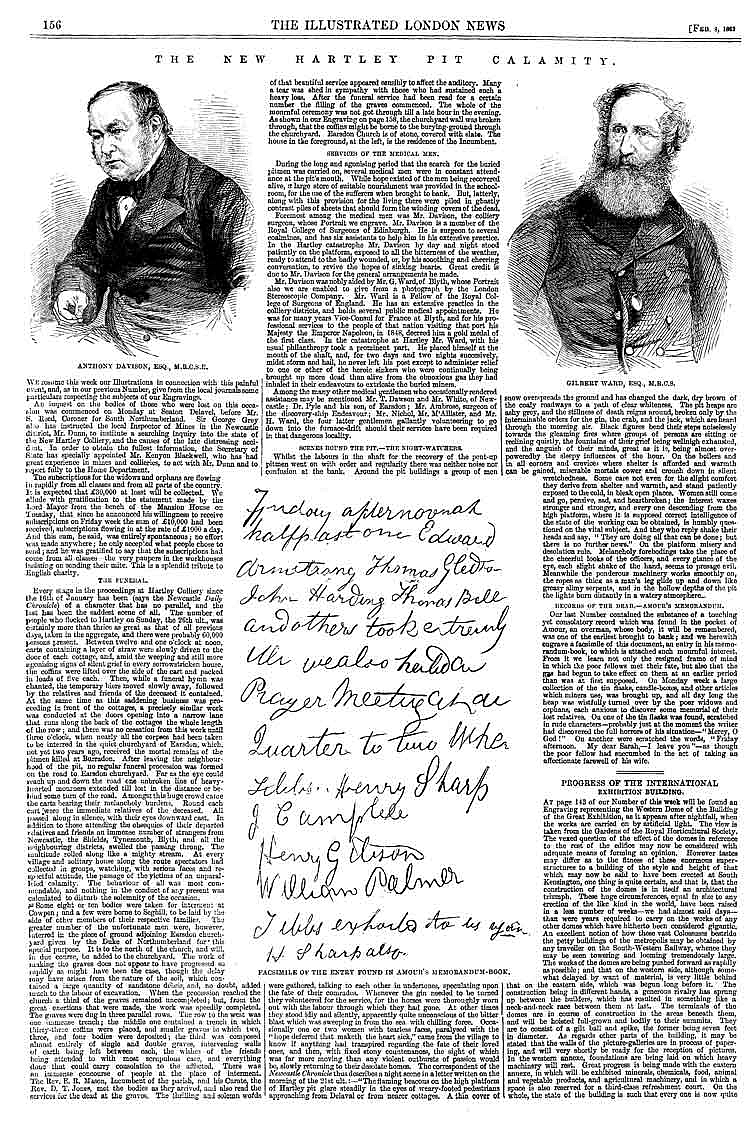
transcription of The New Hartley Pit Calamity (above)
Page 156 FEBRUARY 5TH, 1862
THE ILLUSTRATED LONDON NEWS
THE NEW HARTLEY PIT CALAMITY.
We resume this week our Illustrations in connection with this painful event,
and, as in our previous Number, give from the local journals some particulars
respecting the subjects of our Engravings.
An inquest on the bodies of those who were lost on this occasion was commenced
on Monday at Seaton Delavel, before Mr. S. Reed, Coroner for South Northumberland.
Sir George Grey also has instructed the local Inspector of Mines in the Newcastle
district, Mr. Dunn, to institute a searching inquiry into the state of the New
Hartley Colliery, and the causes of the late distressing accident. In order
to obtain the fullest information, the Secretary of State has specially appointed
Mr. Kenyon Blackwell, who has had great experience in mines and collieries,
to act with Mr. Dunn and to report fully to the Home Department.
The subscriptions for the widows and orphans are flowing in rapidly from all
classes and from all parts of the country. It is expected that £30,000
at least will be collected. We allude with gratification to the statement made
by the Lord Mayor from the bench of the Mansion House on Tuesday, that since
he announced his willingness to receive subscriptions on Friday week the sum
of £10,000 had been received, subscriptions flowing in at the rate of
£1000 a day. And this sum, he said, was entirely spontaneous; no effort
was made anywhere; be only accepted what people chose to send; and he was gratified
to say that the subscriptions had come from all classes the very paupers in
the workhouses insisting on sending their mite. This is a splendid tribute to
English charity.
THE FUNERAL
Every stage in the proceedings at Hartley Colliery since the 16th of January has been (says the Newcastle Daily Chronicle) of a character that has no parallel, and the last has been the saddest scene of all. The number of people who flocked to Hartley on Sunday, the 26th ult., was certainly more than thrice as great as that of all previous days, taken in the aggregate, and there were probably 60,000 persons present. Between twelve and one o’clock at noon, carts containing a layer of straw were slowly driven to the door of each cottage, and, amid the weeping and still more agonising signs of silent grief in every sorrow stricken house, the coffins were lifted over the side of the cart and packed in loads of five each. Then, while a funeral hymn was chanted, the temporary biers moved slowly away, followed by the relatives and friends of the deceased it contained. At the same time as this saddening business was proceeding in front of the cottages, a precisely similar work was conducted at the doors opening into a narrow lane that runs along the back of the cottages the whole length of the row; and there was no cessation from this work until three o’clock, when nearly all the corpses had been taken to be interred in the quiet churchyard of Earsdon, which, not yet two years ago, received the mortal remains of the pitmen killed at Burradon. After leaving the neighbourhood of the pit, no regular funeral procession was formed on the road to Earsdon churchyard. Far as the eye could reach up and down the road one unbroken line of heavyhearted mourners extended till lost in the distance or behind some turn of the road. Amongst this huge crowd came the carts bearing their melancholy burdens. Round each cart were the immediate relatives of the deceased. All passed along in silence, with their eyes downward cast. In addition to those attending the obsequies of their departed relatives and friends an immense number of strangers from Newcastle, the Shields, Tynemouth, Blyth, and all the neighbouring districts, swelled the passing throng. The multitude rolled along like a mighty stream. At every village and solitary house along the route spectators had collected in groups, watching, with serious faces and respectful attitude, the passage of the victims of an unparalleled calamity. The behaviour of all was most commendable, and nothing in the conduct of any present was calculated to disturb the solemnity of the occasion.
Some eight or ten bodies were taken for interment at Cowpen; and a few were
borne to Seghill, to be laid by the side of other members of their respective
families. The greater number of the unfortunate men were, however, interred
in the piece of ground adjoining Earsdon church yard given by the Duke of Northumberland
for this special purpose. It is to the north of the church, and will, in due
course, be added to the churchyard. The work of making the graves does not appear
to have progressed so rapidly as might have been the case, though the delay
may have arisen from the nature of the soil, which contained a large quantity
of sandstone debris, and, no doubt, added much to the labour of excavation.
When the procession reached the church a third of the graves remained uncompleted;
but, from the great exertions that were made, the work was speedily completed.
The graves were dug in three parallel rows, The row to the west was one immense
trench; the middle one contained a trench in which thirty-three coffins were
placed, and smaller graves in which two, three, and four bodies were deposited;
the third was composed almost entirely of single and double graves, intervening
walls of earth being left between each, the wishes of the friends being attended
to with most scrupulous care, and everything done that could carry consolation
to the afflicted, There was an immense concourse of people at the place of interment.
The Rev. E. R. Mason, Incumbent of the parish, and his Curate, the Rev. B. T.
Jones, met the bodies as they arrived, and also read the services for the dead
at the graves. The thrilling and solemn words of that beautiful service appeared
sensibly to affect the auditory. Many a tear was shed in sympathy with those
who had sustained such a heavy loss. After the funeral service had been read
for a certain number the filling of the graves commenced. The whole of the mournful
ceremony was not got through till a late hour in the evening. As shown in our
Engraving on page 158, the churchyard wall was broken through, that the coffins
might be borne to the burying-ground through the churchyard. Earsdon Church
is of stone, covered with slate. The house in the foreground, at the left, is
the residence of the Incumbent.
SERVICES OF THE MEDICAL MEN
During the long and agonising period that the search for the buried pitmen was
carried on, several medical men were in constant attendance at the pit’s
mouth. While hope existed of the men being recovered alive, a large store of
suitable nourishment was provided in the schoolroom, for the use of the sufferers
when brought to bank. But, latterly, along with this provision for the living
there were piled in ghastly contrast piles of sheets that should form the winding
covers of the dead.
Foremost among the medical men was Mr. Davison, the colliery surgeon, whose
Portrait we engrave. Mr. Davison is a member of the Royal College of Surgeons
of Edinburgh. He is surgeon to several coalmines, and has six assistants to
help him in his extensive practice. In the Hartley catastrophe Mr. Davison by
day and night stood patiently on the platform, exposed to all the bitterness
of the weather, ready to attend to the badly wounded, or, by his soothing and
cheering conversation, to revive the hopes of sinking hearts. Great credit is
due to Mr. Davison for the general arrangements he made.
Mr. Davison was nobly aided by Mr. G. Ward, of Blyth, whose Portrait also we
are enabled to give from a photograph by the London Stereoscopic Company. Mr.
Ward is a Fellow of the Royal College of Surgeons of England. He has an extensive
practice in the colliery districts, and holds several public medical appointments.
He was for many years Vice-Consul for France at Blyth, and for his professional
services to the people of that nation visiting that port his Majesty the Emperor
Napoleon, in 1848, decreed him a gold medal of the first class. In the catastrophe
at Hartley Mr. Ward, with his usual philanthropy took a prominent part. He placed
himself at the mouth of the shaft, and, for two days and two nights successively,
midst storm and hail, he never left his post except to administer relief to
one or other of the heroic sinkers who were continually being brought up more
dead than alive from the obnoxious gas they had inhaled in their endeavours
to extricate the buried miners.
Among the many other medical gentlemen who occasionally rendered assistance
may be mentioned Mr. T. Dawson and Mr. White, of Newcastle; Dr. Pyle and his
son, of Earsdon; Mr. Ambrose, surgeon of the discovery-ship Endeavour; Mr. Nichol,
Mr. M’Allister, and Mr. H. Ward, the four latter gentlemen gallantly volunteering
to go down into the furnace-drift should their services have been required in
that dangerous locality.
RECORDS OF THE DEAD.—AMOURS MEMORANDUM.
Our last Number contained the substance of a touching yet consolatory record which was found in the pocket of Amour, an overman, whose body, it will be remembered, was one of the earliest brought to bank; and we herewith engrave a facsimile of this document, an entry in his memorandum-book, to which is attached such mournful interest. From it we learn not only the resigned frame of mind in which the poor fellows met their fate, but also that the gas had begun to take effect on them at an earlier period than was at first supposed. On Monday week a large collection of the tin flasks, candle-boxes, and other articles which miners use, was brought up, and all day long the heap was wistfully turned over by the poor widows and orphans, each anxious to discover some memorial of their lost relatives. On one of the tin flasks was found, scratched in rude characters—probably just at the moment the writer had discovered the full horrors of his situation—” Mercy, O God!” On another were scratched the words, “Friday afternoon. My dear Sarah,—I leave you—” as though the poor fellow had succumbed in the act of taking an affectionate farewell of his wife.

The Hartley colliery Monument in Earsdon Churchyard (March 10 1866)
Joseph Skipsey wrote this poem
The Hartley Calamity
The Hartley men are noble, and ye'll hear a tale of woe,
I'll tell the doom of the Hartley men - The year of sixty two.
'Twas on the Thursday morning, in the first month of the year,
When there befell the thing that well may rend the heart to hear.
Ere chantecleer with music rare awakes the old homestead,
The Hartley men are up and off to earn their daily bread.
On, on they toil, with heat they broil, and streams of sweat still glue
The stour into their skins, till they are black as the coals they hew.
Now to and fro the putters go, The waggons to and fro,
And clang on clang the wheel and hoof ring in the mine below.
The din and strife of human life awakes in 'wall' and 'board',
When, all at once a shock is felt which makes each heart-beat heard.
Each bosom thuds, as each his duds then snatches and away,
And to the distant shaft he flees with all the speed he may.
Each, all, they flee by two, by three, they seek the shaft to seek
An answer in each other's face to what they may not speak.
Are we entombed? they seem to ask, for the shaft is closed, and no
Escape have they to God's bright day from out the night below.
So stand in pain the Hartley men, and swiftly o'er them comes
The memory of home and all that binds us to our homes.
Despair at length renews their strength, and they the shaft must clear,
And soon the sound of mall and pick half drowns the voice of fear.
And hark, to the sound of the mall below, do the sounds above reply?
Hurrah, hurrah for the Hartley men, for now their rescue's nigh.
Their rescue nigh? The sound of joy and hope have ceased, and ere
A breath is drawn a rumble’s heard that drives them to despair.
Together now behold them bow, their burdened souls unload
In cries that never rise in vain unto the living God.
Whilst yet they kneel, again they feel their strength renewed again
The swing and the ring of the mall attest the might of the Hartley men.
And hark, to the blow of the mall below, do sounds above reply?
Hurrah, hurrah, for the Hartley men, for now their rescue's nigh!
But now that light, erewhile so bright, no longer lights the scene,
A cloud of mist the light has kissed and shorn it of its sheen.
A cloud of mist the light has kissed, and see, along does crawl,
Till one by one the lights are smote, and darkness covers all.
‘Oh, father, till the shaft is cleared, close, close besides me keep.
My eyelids are together glued, and I - and I must sleep.’
‘Sleep, darling, sleep, and I will keep close by - heigh-ho-’ To keep
Himself awake the father strives, but soon he too must sleep.
And fathers and mothers and sisters and brothers, the lover, the new-made bride,
A vigil kept for those who slept from eve to morning tide.
But they slept, still sleep, in silence dread, two hundred old and young,
To awake when heaven and earth have sped and the last dread trumpet sung.
Links...
Home Page - Year Grid - Contact John - Join our Facebook Group