p 404
Having last week introduced this important subject to our readers, and given
them some of the statistics of Kilrush, we shall henceforward allow our Correspondent
to speak for himself: --
I assure you (he says) that the objects of which I send you Sketches are not
sought after -- I do not go out of my way to find them: and other travellers
who have gone in the same direction, such as Lord Adair, the Earl of Surrey,
and Mr. Horsman, will vouch, I am sure, for the accuracy of my delineations.
The Sketch of Moveen, to which I now call your attention, is that of another
ruined village in the Union of Kilrush. It is a specimen of the dilapidation
I behold all around. There is nothing but devastation, while the soil is of
the finest description, capable of yielding as much as any land in the empire.
Here, at Tullig, and other places, the ruthless destroyer, as if he delighted
in seeing the monuments of his skill, has left the walls of houses standing,
while he has unroofted them and taken away all shelter from the people. They
look like the tombs of a departed race, rather than the recent abodes of a
yet living people, and I felt actually relived at seeing or two half-clad
spectres gliding about, as an evidence that I was not in the land of the dead.
You may inquire, perhaps, and I am sure your readers will wish to know,
why it is that the people have of late been turned out of their houses insuch
great numbers, and their houses just at this time pulled own, and I will give
you my explanation of the fact.
The public records, my own eyes, a piercing wail of woe throughout the land
-- all testify to the vast extent of the evictions at the present time.
Sixteen thousand and odd persons unhoused in the Union of Kilrush before
the month of June in the present year;
seventy-three thousand one-hundred and thirty holdings done away in Ireland
and nearly as many houses destroyed in less than five acres, put an end to
between 1841 and 1848; six-tenths, in fact, of the lowest class of tenantry
driven from their now roofless or annihilated cabins and houses, make up the
general description of the desolation of which Tullig and Moveen are examples.
The ruin is great and complete. The blow that effected the character of
the last and best friend of the peasantry, and it has struck them to the heart.
They are prostrate and helpless. The once frolicsome people -- even the saucy
beggars -- have disappeared, and given place to wan and haggard objects, who
are so resigned to their doom, that they no longer expect relief.
One beholds only shrunken frames scarcely covered with flesh -- crawling
skeletons, who appear to have risen from the graves, and are ready to return
frightened to that abode. They have little other covering than that nature
has bestowed on the human body -- a poor protection against inclement weather;
and now that the only hand from which they expected help is turned against
them, even hope is departed, and they are filled with despair.
Than the present Earl of Carlisle there is not a more humane nor a kinder-hearted
nobleman in the kingdom; he is of high honour and unsullied reputation; yet
the Poor-law he was mainly the means of establishing for Ireland, with the
best intentions, has been one of the chief causes of the people being at this
time turned out of their homes, and forced to burrow in holes, and share,
till they are discovered, the ditches and bogs with otters and snipes.

The instant the Poor Law was passed, and property was made responsible for poverty,
the whole of the landowners, who had before been careless about the people,
and often allowed them to plant themselves on untenanted spots, or divide their
tenancies -- delighted to get the promise of a little additional rent -- immediately
became deeply interested in preventing that, and in keeping down the number
of the people.
Before they had rates to pay, they cared nothing for them; but the law and
their self-interest made them care, and made them extirpators. Nothing less
than some general desire like that of cupidity falling in with an enactment,
and justified by theory -- nothing less than a passion which works silently
in all, and safely under the sanction of the law --could have effected such
widespread destruction.
Even humanity was enlisted by the Poor-Law on the side of extirpation. As
long as there was no legal provision for the poor, a landlord had some repugnance
to drive them from every shelter; but the instant the law took them under
its protection, and forced the landowner to pay a rate to provide for them,
repugnance ceased; they had a legal home, however insufficient, to go to;
and eviction began. Even the growth of toleration seems to have worked to
the same end. Till the Catholics were emancipated, they were all -- rich and
poor, priests and peasants -- united by a common bond; and Protestant landlords
beginning evictions ona great scale, would have roused against them the whole
Catholic nation. It would have been taken up as a religious question, as well
as a question of the pooor, prior to 1829. Subsequent to that time -- with
a Whig administration, with all offices open to Catholics -- no religious
feelings could mingle with with the matter: eviction became a pure question
of interest; while the priests look now, perhaps, as much to the Government
as to their flocks for support, Catholic landlords are not behind Protestant
landlords in clearing their estates. English notions and English habits, without
any reference to the causes of English greatness -- which are not to be found
in Poor-law and farms of a particular size -- impressed law-makers and the
landlords of Ireland with a strong desire to enlarge and consolidate farms,
and clear them of the squatters and subtenants, who had formerly been permitted,
if not encouraged. With a Poor law, that desire could safely be acted on,
and so it supplies a temptation and the means to carry eviction extensively
into effect.
The evictions were numerous before the potato rot. It was not that great calamity,
therefore , that superinduced them, or was the chief cause of the present desolation.
The potato harvest and harvests of every kind have been lost many times before
1846, without reducing the people to their present misery. But that calamity
threw the people at the mercy of the Government,and the Government used its
power directly and indirectly, in accordance with the theory, to clear the land.
Out-door relief was established in that season of distress, and relief altogether
was coupled with the resignation of the land. The poor were required to give
up their heritage, small though it was, for less than a mess of pottage.

A law was passed, the 11 and 12 Vic. c. 47, entitled "An Act for the Protection
and Relief of the Destitute Poor Evicted from their Dwellings," which provided
a means of evicting them, subjecting the landlords to the necessity of giving
notice to Poor-law guardians, and to the share of a common burden. Under such
stimuli and such auspices, the clearing process has gone on in an accelerated
ratio, with Ireland is now dotted with ruined villages, and filled with a
a starving population, besieging the doors of crowded workhouses, and creeping
into the halls and chambers of the deserted mansions of the nobility and gentry.
A gentleman's mansion turned into a poor-house, is a fit emblem of the decay
that a mistaken policy has brought on all classes. The system intended to
relieve the poor, by making the landlord responsible for their welfare, has
at once made it the interest, and therefore the duty, of the landlords to
get rid of them. Extirpation is accordingly going forward at a rapid rate;
and the evidence of that is now placed before the eyes and the understanding
of the readers of the ILLUSTRATED LONDON NEWS.
I will give you, by and by, some notices of the driving for rent, of landowners
impoversished by rates, and of bankruptcy unions; but at present I must give
attention to some of the other Sketches I send.
The Scalp of Brian Connor (here represented) has been already described;
it is another illustration of the worse than pig-sty habitations of those
who did live in the now roofless cottages.
Another Sketch follows (that of Miss Kennedy), which shows that, amidst
this world of wretchedness, all is not misery and guilt. Indeed, it is a part
of our nature that the sufferings of some should be the occasions for the
exercise of virtue in others. Miss Kennedy (about seven years old) is the
daughter of Captain Kennedy, the Poor-Law inspector of the Kilrush Union.
She is represented as engaged in her daily occupation of distributing clothing
to the wretched children brought around her by their more wretched parents.
In the front of the group I noticed one woman crouching like a monkey, and
drawing around her the only rag she had to conceal her nudity. A big tear
was rolling down her cheek, with gratitude for the gifts the innocent child
was distributing. The effect was heightened by the chilliness and dreariness
of a November evening, and by the wet and mire in which the naked feet of
the crowd were immersed.

On Captain Kennedy being appointed to the Union, his daughter was much affected
by the misery of the poor children she saw; and so completely did it occupy
her thoughts, that, with the consent ofher parents, she gave up her time and
her own little means to relieve them. She gave away her own clothes -- she
was allowed to bestow part of her mother's -- and she then purchased coarse
materials and made up clothing for children of her own age; and she was encouraged
by her father and some philanthropic strangers, from whom she received sums
of money, and whose example will no doubt be followed by those who possess
property in the neighborhood; and she devoted herself with all the energy
and perserverance of a mature and staid matron to the holy office she has
undertaken. The Sketch will, I hope, immortalize the beneficent child, who
is filling the place of a saint, and performing the duties of a patriot.
On all sides I hear praises of the amiable child and her excellent father,
and this is not without a moral for the landlords. The public officers who
are appointed to administer and control the relief of the poor, have it in
their power to do much for the people. Mere kindness of manner, though they
render no substantial assistance, endears them to the suffering crowd. Captain
Kennedy is at once kind, charitable and judicious. He is at the head of the
Union. He fills for the people the most important office in the district.
He is the great man of the place. It must be so in other districts. The funds
are contributed by the landowners, but they are distributed by public officers.
Thus the Poor Law, which disposes of the landowner's property, also deprives
them of the pleasure and the burden of distributing it themselves. A public
officer is made, in fact, to administer their estates, and he stands between
them and their compulsory bounties, securing the respect and confidence which
they might and ought to have. The more the subject is examined, the more I
have no doubt, it will be found that the Poor Law is as injurious to the landlords
as it is to the people.
"'Searching for Potatoes' is one of the those occupations of those who cannot
obtain outdoor relief. It is gleaning in a potato field, and how few are left
after the potatoes are dug, must be known to everyone who has ever seen the
field cleared. What the people were digging and hunting for, like dogs after
truffles, I could not imagine, till I went into the field, and then I found
them patiently turning over the whole ground, in the hopes of finding the
few potatoes the owner might not have overlooked. Gleaning ina potato field
seems something like shearing hogs, but it is the only means by which the
gleaners could hope to get a meal."
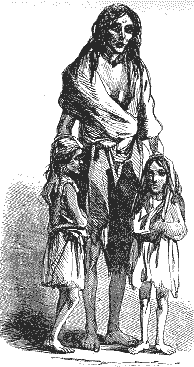
"The Sketch of a Woman and Children" represents Bridget O'Donnell. Her story
is briefly this: 'I lived,' she said, 'on thelands of Gurranenatuoha. My husband
held four acres and a half of land, and three acres of bog land; our yearly
rent was L7 4s; we were put out last November; he owed some rent. We got thirty
stone of oats from Mr. Marcus Keane, for seed. My husband gave some writing
for it; he was paid for it. He paid ten shillings for reaping the corn. As
soon as it was stacked, one 'Blake' on the farm, who was put to watch it,
took it away in his own haggard and kept it there for a fortnight by Dan Sheedey's
orders. The then thrashed it in Frank Leille's barn. I was at this time lying
in fever. Dan Sheedey and five or six men came to tumble my house; they wanted
me to give possession. I said that I would not; I had fever, and was within
two months of my down-lying (confinement); they commenced knocking down the
house, and had half of it knocked down when two neighbors, women, Nell Spellesley
and Kate How, carried me out. I had the priest and the doctor attend me shortly
after. Father Meehan annointed me. I was carried into a cabin and lay there
for eight days, when I had the creature (the child) born dead . I lay for
three weeks after that. The whole of my family got the fever, and one boy
thirteen years old died with wants and with hunger while we were lying sick.
Dan Sheedey and Blake took the corn into Kilrush and sold it. I don't know
what they got for it. I had not a bit for my children to eat when they took
it from me."
The last Sketch shows the Scalpeen of Tom Downs, at Dunmore, in the parish
of Kellard, where himself and his ancestors resided on this spot for over
a century, with renewal of their lease up to 1845. He neither owed rent arrears
or taxes up to the present moment, and yet he was pitched out onto the roadside,
and saw then other houses, with his own, levelled at one fell swoop on the
spot, the ruins of some of which are seen in this Sketch. None of them were
mud cabins, but all capital stone-built houses.
I must conclude my present communications with an account of a great catastrophe
which has hurried 37 of the poor wretches that depended on the Union of Kilrush,
with four other persons, into eternity. The Union will be relieved by an accident
at which humanity mourns: "On the evening of Wednesday week intelligence reached
the town of Kilrush that a large number of persons, most of whom were paupers,
who had been seeking outdoor relief at Kilrush, were drowned while crossing
the ferry on their return to Moyarta. No less than 33 dead bodies were washed
ashore on the northern side of the ferry. They were removed to an adjacent
field, and the coroner, Mr. Frank O'Donnell, arriving soon after from Kilkee,
an inquest was held on their wretched remains. It appeared upon the inquiry
that no less than 43 or 45 persons (for they could not tell the exact number)
were allowed to crowd into a crazy and rotten boat, which has been plying
on this ferry for the last forty years. The boat moved on as far as the middle
of the ferry, when a sea broke over her stern, and filled her at once, the
wind blowing strong from the southwest at the time. She upset immediately,
and her miserable living freight were immersed in the merciless waters, while
four (who were eventually saved) clung to her until a boat from Captain Cox's
men came to their assistance. The verdict of the coroner's jury was as usual
in such cases, but imputing gross neglect and attaching censure to the owners
of the boat, for admitting such a number of persons into so frail a craft.
With the exception of four, the victims were all paupers who had frequently
come into the town in vain to seek out door relief, and were returning that
sad evening to their wretched hovels in the parishes of Moyarta and Kilballyowen.
The
full account of the 1849-50 Famine - Illustrated London News - reports
here in the Clare County Library

 Emigrants on deck of ship bound for Australia