Palestine 1936 part 2
The Arab Revolt — Illustrated London News Collection
These pages collects ILN coverage and related material documenting the 1936–1939 Arab Revolt in Palestine — a critical prelude to the events of 1948.
Between 1936 and 1939 Palestine was shaken by a major uprising against British rule and growing Jewish immigration. Known as the Arab Revolt, it began with a general strike in April 1936 and escalated into widespread unrest — strikes, civil disobedience and armed guerrilla actions. The British responded with military force and political commissions, notably the Peel Commission (1937), which for the first time formally proposed partition as a solution.
The uprising reflected long-standing grievances: land transfers and tenancy losses associated with Zionist land purchase; economic displacement and unemployment among Arab workers; and political frustration at the absence of meaningful Arab self-government under the British Mandate, especially after the 1917 Balfour Declaration.
Key figures (brief)
- Haj Amin al-Husseini — Grand Mufti of Jerusalem; prominent political leader and head of the Arab Higher Committee during 1936.
- Izz ad-Din al-Qassam — Militant preacher (killed 1935); his killing helped galvanise anti-British sentiment that fed into 1936 unrest.
- Abd al-Rahim al-Hajj Muhammad — Principal field commander in the central highlands, led prolonged guerrilla action in 1938–39.
- Fawzi al-Qawuqji — Arab volunteer commander who led irregular forces active in and around Palestine.
- Sir Arthur Wauchope — British High Commissioner (1931–1938) who presided over Mandate security responses.
- Lord Peel — Chaired the 1937 Royal Commission (Peel Commission) that proposed partition.
(All names are well-documented in British mandate records, ILN reportage and modern histories.)
Short historical note
The revolt ran from April 1936 to 1939. It combined urban strike action and rural guerrilla warfare. Britain deployed increasing security forces and introduced emergency regulations; thousands were arrested, and many Palestinian political organisations were weakened or banned. The Peel Commission (1937) and subsequent White Paper (1939) shaped the political debate but did not resolve the conflict; the decline of Palestinian organisation during these years was a key factor leading into the later 1947–48 crisis.
The Strike
In April 1936, growing tensions in British-ruled Palestine erupted into a six-month general strike. Palestinian Arabs, alarmed by increasing Jewish immigration and the loss of agricultural land, called for a shutdown of shops, transport, and tax payments to pressure the British authorities.
What began as civil resistance soon developed into the first phase of the Arab Revolt (1936–1939). Attacks on railways and police posts, curfews, reprisals, and tightened security measures turned the country into a conflict zone. The British administration, supported by the Jewish Haganah, sought to restore order while navigating the competing demands of both communities.
The strike ended in October 1936 after Arab leaders were urged by regional kings to pause the unrest while a British commission investigated the causes. The events of that year marked a turning point, setting the stage for deeper conflict in the years ahead
July 4th to August 1st

A train derailed in Palestine:A lawless act that caused the extension of curfew
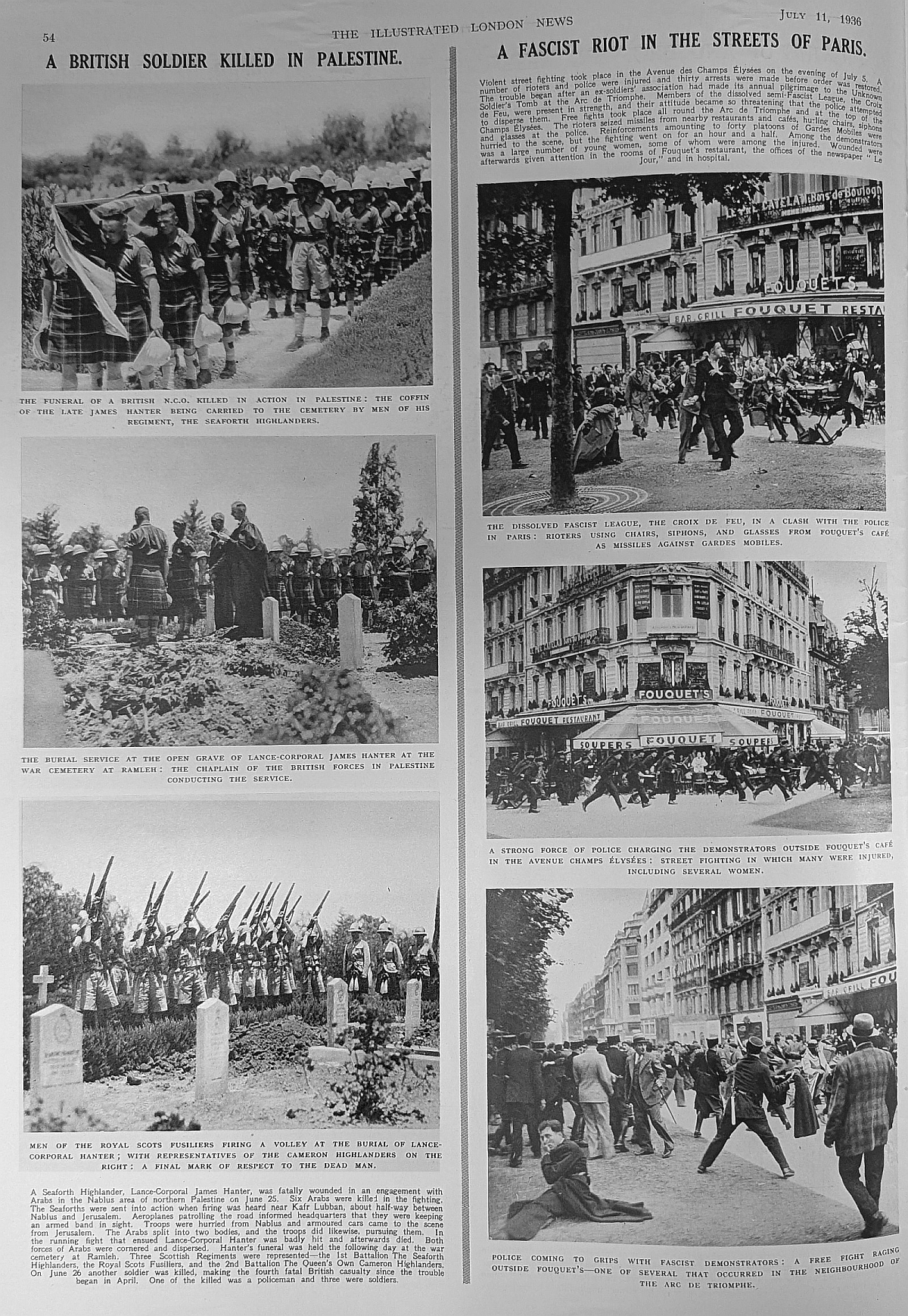
A British soldier killed in Palestine - A Seaforth Highlander, Lance Corporal James Hanter
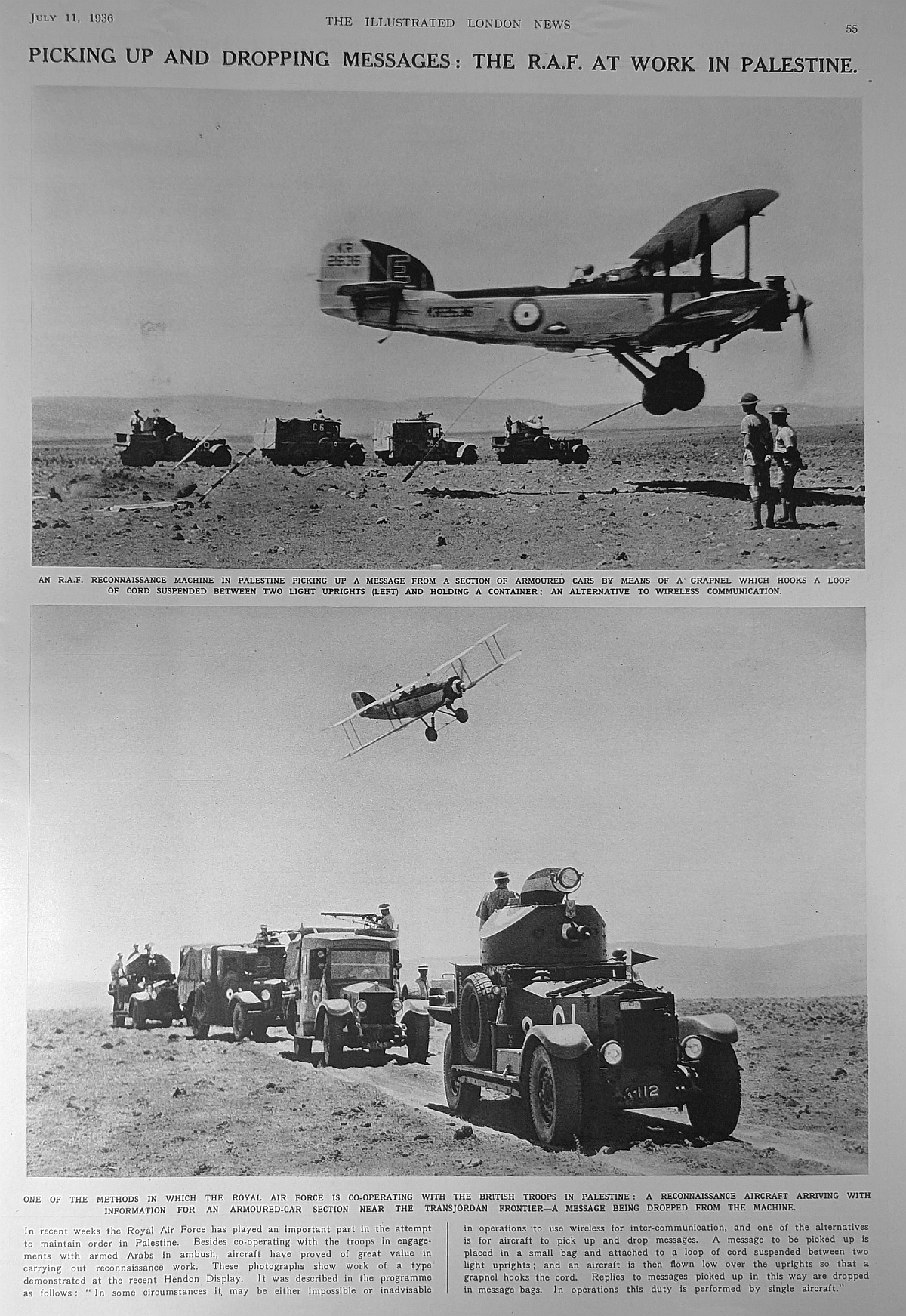
Picking up and dropping messages: The R. A. F. at work in Palestine
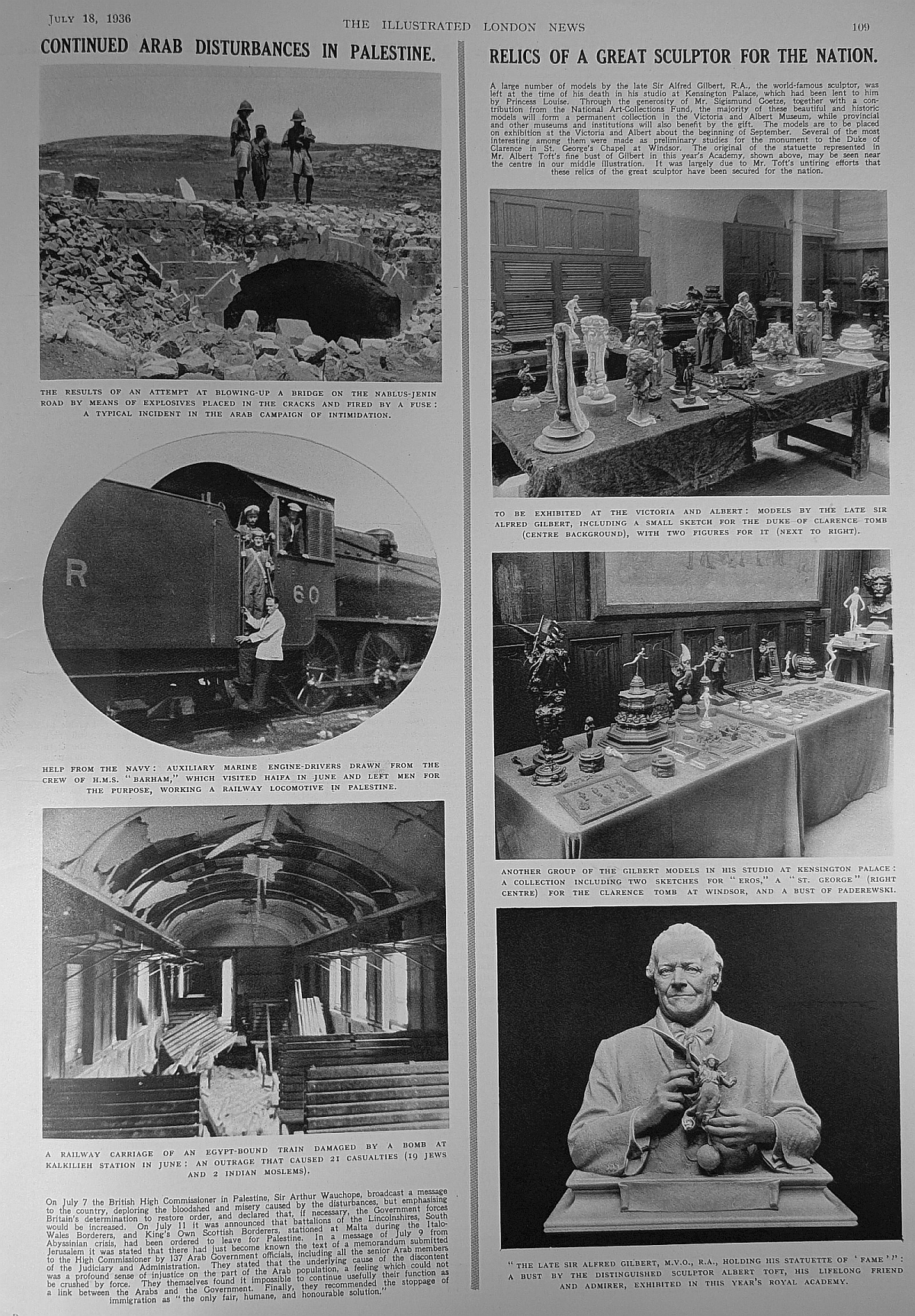
Continued Arab disturbances in Palestine: Railway damage

An armoured wagon attached to a train in Palestine to counter any attack by Arab bandits: A necessary precaution
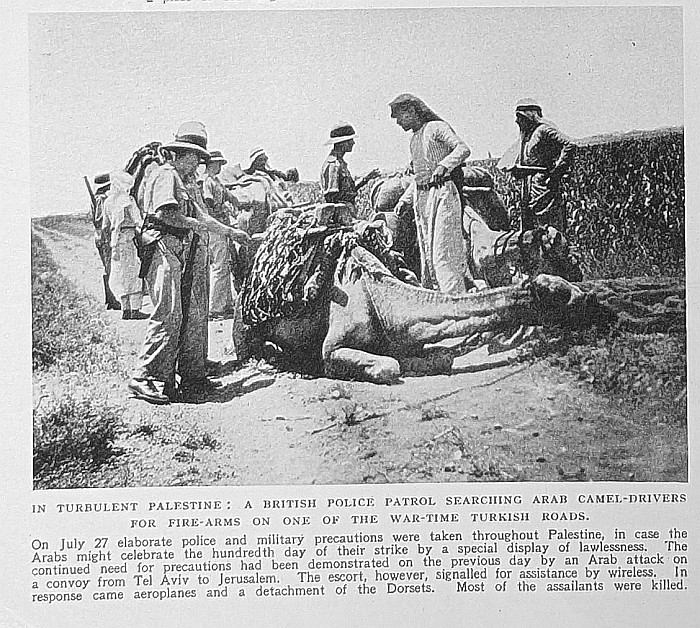
In turbulent Palestine: A British police patrol searching Arab camel drivers for fire-arms on one of the war time Turkish roads
- Peel Commission Report (Cmd. 5479), 1937.
- Mattar, Philip. The Arab Revolt 1936–1939 (selected modern histories).
- Contemporary ILN issues (scanned pages on this site).