search my website...

Home Page - Year Grid - Contact John - Join our Facebook Group

The Illustrated London News
some aspects of
the reports about
Isle of Man
that appeared over the years 1844 - 1857

isle of Man King Wiliam College fire

The King William college fire on The isle of Man January 1844

We regret to record the almost total destruction of this splendid college edifice at Castletown by fire, on Sunday morning last. The fire was discovered about two o’clock, issuing from the school-room, and had already made such progress, that efforts to arrest it, without aid of engines, were wholly ineffectual. Engines were sent for to Douglas, without delay ; but, such was the distance, that before they arrived, the interior of the main building was wholly destroyed. Nothing is saved of that fine edifice but the bare walls, and a part of the east wing in which the Vice- Principal resides ; the very valuable library of the College, containing many works of great rarity, and a curious collection of Bibles, from the time of Coverdale, in upwards of fifty different languages, many unique MSS. relating to Manx ecclesiastical affairs, and the very valuable military models and plans, maps, mathematical and other instruments, many of which cannot be replaced without much labour and expence, belonging to Mr. Browne, the Professor of English and modern literature, were completely destroyed.

The first alarm was given by two boys who were sick of the measles, separated from the other boys, and sleeping immediately over the English class-rooms, who, having perceived a strong smell of fire, gave the alarm. There were about sixty boys sleeping within the college at the time, who were obliged to escape in their night shirts, but not a single accident occurred. The conduct of Mr. Dixon, the Principal, on this trying occasion, entitles him to the highest praise: his first care was to see that the lives of those entitled to his guardian-ship were all safe-—then he bestowed his attention on saving property to the utmost of his power.

King William’s College is a modern erection, about half a mile N.E. from Castletown. The first stone was laid by the late Lieut.Governor Smelt, on the 23d of April, 1830, and it was opened in the summer of 1833. The building is partly in the early English, and partly in the Elizabethan style, forming a spacious and cruciform structure, 210 feet in length from east to west, and 135 feet fromsi north to south ; from the intersection rose the embattled tower, 115 feet high, strengthened with buttresses, and surmounted by an octagonal turret, intended for an observatory, having in each of its sides an elegant amid lofty window, and crowned with a parapet. The edifice cost about £6000, of which £2000 was from the accumulated fund from property granted by Bishop Barrow, in 1668, for the education of young men for the ministry in the Manx Church. From subscriptions, raised chiefly in the island, £2000 was obtained, and the remaining £2000 was supplied by mortgaging the funds. The original draught of the design was furnished by Messrs. Hanson and Welsh, architects ; but the execution of the works, including the alterations and additions, and the design for the great tower—a beautiful specimen of masonry—were under the direction of Mr. Welsh. The contractor was the late Mr. Fitzsimmons, who, it is said, lost £1500 by the contract. The property is vested in the hands of trustees, who are the Lieutenant-Governor, the Lord Bishop, the Clerk of the Rolls, the Archdeacon, Deemster Christian, one Vicar-General, and the Attorney-General. The funds expended in the erection of the edifice were, we believe, aided by generous benefactions from England.


Herring fishing isle of man

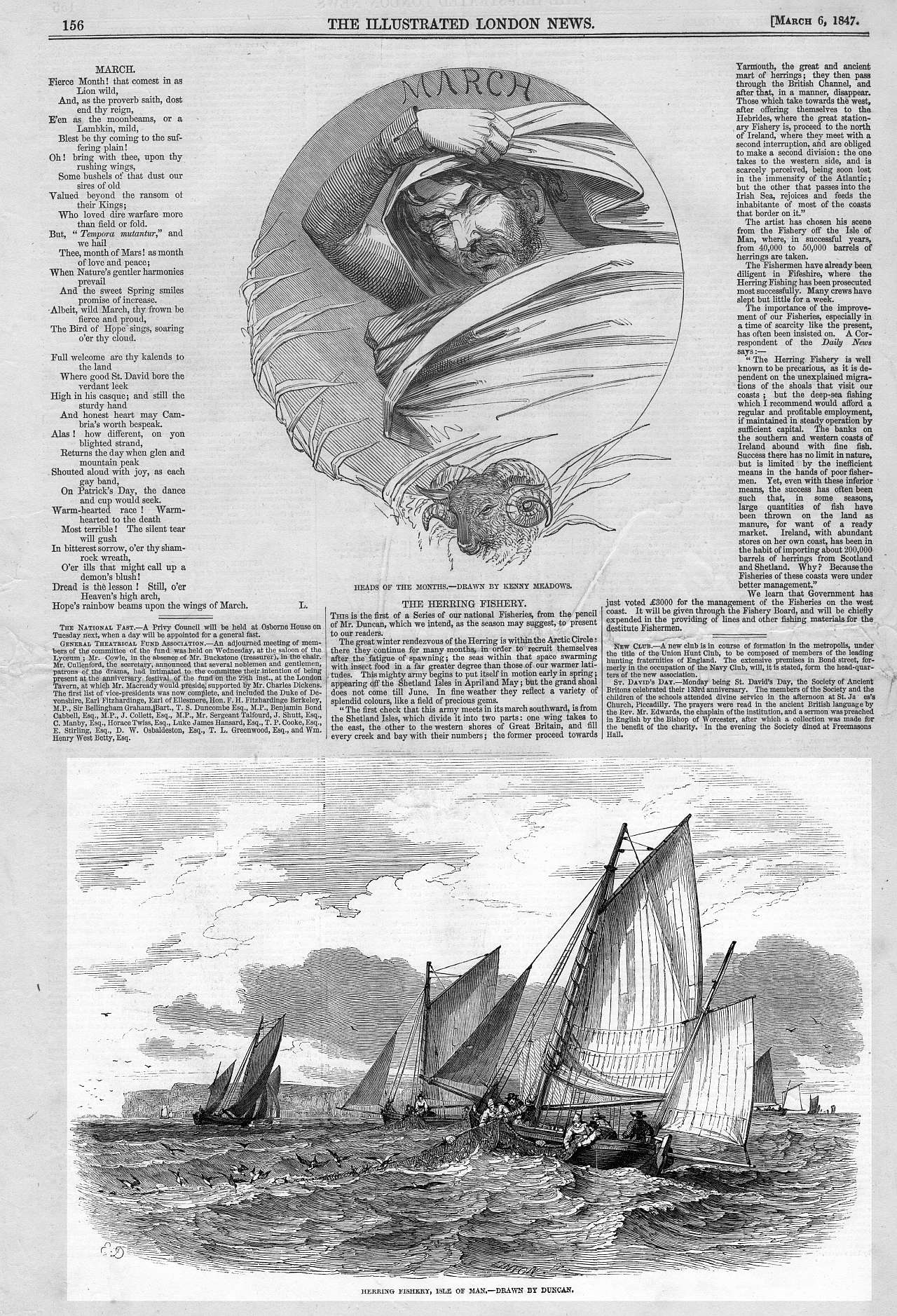
Herring fishery, Isle of Man, 1847

This is the first of a Series of our national Fisheries, from the pencil of Mr. Duncan, which we intend, as the season may suggest, to present to our readers.

The great winter rendezvous of the Herring is within the Arctic Circle there they continue for many months, in order to recruit themselves after the fatigue of spawning; the seas within that space swarming with insect food in a far greater degree than those of our warmer latitudes. This mighty army begins to put itself in motion early in spring; appearing off the Shetland Isles in April and May; but the grand shoal does not come till June. In fine weather they reflect a variety of splendid colours, like a field of precious gems.

"The first check that this army meets in its march southward, is from the Shetland Isles, which divide it into two parts: one wing takes to the east, the other to the western shores of Great Britain, and fill every creek and bay with their numbers; the former proceed towards,Yarmouth, the great and .ancient mart of herrings; they then pas through the British Channel, and after that, in a manner, disappear. Those which take towards the west, after offering themselves to the Hebrides, where the great stationary Fishery is, proceed to the north of Ireland, where they meet with a second interruption, and are obliged to make a second division: the one takes to the western side, and is scarcely perceived, being soon lost in the immensity of the Atlantic; but the other that passes into the Irish Sea, rejoices and feeds the inhabitante of most of the coasts that border on it."

The artist has chosen his scene from the Fishery off the Isle of Man, where, in successful years, from 40,000 to 50,000 barrels of herrings are taken.

The Fishermen have already been diligent in Fifeshire, where the Herring Fishing has been prosecuted most successfully. Many crews have slept but little for a week.

The importance of the improvement of our Fisheries, especially in a time of scarcity like the present, has often been insisted on. A Correspondent of the Daily News says :- The Herring Fishery is well known to be precarious, as it is dependent on the unexplained migrations of the shoals that visit our coasts ; but the deep-sea fishing which I recommend would afford a regular and profitable employment, if maintained in steady operation by sufficient capital. The banks on the southern and western coasts of Ireland abound with fine fish. Success there has no limit in nature, but is limited by the inefficient means in the hands of poor fishermen. Yet, even with these inferior means, the success has often been such that, in some seasons, large quantities of fish have been thrown on the land as manure, for want of a ready market. Ireland, with abundant stores on her own coast, has been in the habit of importing about 200,000 barrels of herrings from Scotland and Shetland. Why? Because the Fisheries of these coasts were under better management.",

We learn that Government has just voted £3000 for the management of the Fisheries on the west coast. It willbe given through the Fishery Board, and will be chiefly expended in the providing of lines and other fishing materials for the destitute Fishermen.


explosion on the isle of Man

Terrific explosion at Kitterland, off the Isle of Man

explosion text

We have received from a Correspondent at Castletown, Isle of Man, the following details of this lamentable scene, dated Dec. 29 :- '

A fearful calamity has just occurred in the south of the Isle of Man, causing deep distress to very many families, and spreading gloom over the whole neighbourhood.

The violent gales, rising occasionally into hurricanes, blowing from the southward and westward from Friday night to Monday afternoon, have done great damage by sea and land. Many vessels have been seen, dismasted, and in distress, drifting down the Channel; and the fragments cast upon our shores indicate great losses at sea. A life-boat bearing the name of the British Queen came on shore in Castletown Bay, on Monday morning.

At twelve o'clock on the same day, the Lily, a vessel of 160 tons register, bound from Liverpool to Ambrazo, on the coast of Africa, with a general cargo, consisting chiefly of bales of cloth, cottons, rum, cannon, firearms, and upwards of forty tons of gunpowder, having been driven back from Cork in a crippled condition, was carried by the tide from the westward into the Sound of the Calf of Man, the breadth of which is about 500 yards; and, in endeavouring to pass between the Kitterland islet and the southern extremity of the Isle of Man, was swung round in the current, which here runs, at some periods of the tide, at the rate of nine knots per hour, and struck on the northern point of the Kitterland. With difficulty, nine of the crew got upon the islet; the master, his son, and three of the crew being carried away by the surf, and drowned in the attempt; two of the nine also being severely injured.

In the course of the afternoon the vessel was handed over to the care of Lloyd's agent at Port St. Mary, distant about two miles, and he subsequently took possession of her. He was assisted in the charge by the chief constable of Castletown and one of his subordinates, and by the constable of Port St. Mary and several others, who were stationed on the vessel, as well as on the Kitterland and the Main Island, to guard the wreck, and land the stores when the weather and tide should permit. It appears that during the night of Monday several shots were fired to deter people from venturing near, some parties having made attempts at plunder.

At five minutes to eight on Tuesday morning the inhabitants of the whole of the south of the Isle of Man were alarmed at a fearful explosion and on looking towards the Calf of Man beheld a vast column of fire and smoke ascending to a great height in the air. The houses were shaken as if by an earthquake, even beyond Douglas, a distance of eighteen miles. The spot where the catastrophe took place is wild in the extreme. The southern extremity of the Isle of Man terminates in the Mull Hills, rising nearly 600 feet above the sea, bold cliffs of clay schist occupy the coasts from the Chasms and Spanish Head, round to Bradda Head and Port Erin.

Laxey water wheel

GIGANTIC WATER-WHEEL.,

The starting of a stupendous Water-wheel, recently added to the works of the Laxey Glen Mines, in the Isle of Man, was attended with an interesting ceremony, on the 27th ult. The mines, we understand. are held under lease from the Crown, at 1-12th Royalty. They produce about 90 tons of silver-lead ore per month, yielding 50 ounces of silver to the ton; and also about 260 tons of zinc ores monthly. The works include eight large water-wheels, and one steam-engine; and the company are about to erect three additional water-wheels: one 16 feet in diameter, and two 50 feet. The starting of the gigantic Wheel recently added was commemorated by an industrial fete by between 3000 and 4000 persons, from all parts of the island, to witness so great an achievement as (according to the Manx Sun) the completion of the "largest wheel in Europe." We have only space to describe the naming ceremony.

The workpeople-between 500 and 600 in number-dressed in holiday clothes, accompanied by two bands of music, walked from the washing-floors to the large Wheel, headed by the Chairman of the Directors. George W. Dumbell, Esq.; and the Agent of the Mines. Captain Rowe; who, on their arrival at the Wheel, conducted the Governor and his lady. the Lord Bishop and his lady, and Mrs. Dumbell, to the first iplatform, where his Excellency, by means of a small handle, let on the water to the Wheel, which immediately commenced moving. Simultaneously with the first motion of the Wheel Mr. Dumbell. gracefully threw the bottle, ornamented with lace and filed with champagne, and named the Wheel "Lady Isabella," in honour of governor's lady. At the same moment a flag at the top of the wheel was unfurled, and made known the title to the assembled crowds, who greeted it with loud cheers, while the shouts from the strong lungs of the workpeople vied with the booming of the cannon in proclaiming the satisfactory accomplishment of a great undertaking.

The workpeople were then regaled upon a neighbouring green with substantial fare; after which they enjoyed themselves in various games. The guest's of the Mining Company were entertained in a building which had been erected upon the green for the occasion. A variety of toasts were drunk, not forgetting "The Miners," proposed by his Excellency the Governor of the Island.

The day's rejoicing concluded with a display of fireworks from the viaduct near the new washings.

The new Wheel forms a conspicuous object in the picturesque glen of Laxey. Its vast dimensions are first noticed by the visitor, when descending the new road from Douglas. A host of little white cottages now stud the slopes on each side of the glen, many encircled by a clump of trees; at the bottom of the glen is a neat little church recently erected, and the new washings, where some hundred men and boys are busily employed attending to the machinery which crushes and washes the ore; further up, the mine is entered by a level, where all the ore passes out; towering above is the large Wheel sitting on its handsome case, on the end of which the Manx Arms figure in gigantic proportions; several other wheels and engine houses are seen still higher up the glen, and forming a background to all stands Snafileld, the monarch of the Manx mountains. On coming to a closer inspection of the Wheel, next to surprise at its great dimensions and maje-tic motion, an apparent want strikes the eye of the unscientific visitor, viz ,the absence of any aqueduct to the top, or even in a line with the centre of the Wheel; a long row of white arches are certainly seen approaching it, but they are found merely to bear the long connecting rod which moves backwards and forwards applying the power of the Wheel to work the pump at the mine shaft, which is distant some two hundred yards from the Wheel. If, however, the visitor will go to the top of a neighbonring elevation, a large reservoir will be found, filled by a small stream of water; from the reservoir an iron tube about two feet in diameter passes under the surface to the foot of the Wheel, whence it rises perpendicalarly in the centre of a slender white tower to the level of the reservoir, then passes under the platform over the Wheel, and pouring on to it, returns in the opposite direction; for the Wheel is what is termed a " breast-shot," and the water does not pass right over the top as an,"over-shot." The axle of the Wheel reste on the top of a substantial oblong ereotion in whioh the lower half revolves; this casing is not merely an enormous stone building, but shows great taste of design, the lower part being pieroed by arched openings, which give it a light appearanoe, and allow the Wheel to be seen.

The Wheel is 72 feet 6 inches in diameter, and 6 feet broad clear in the water way. The burthen is moved from the centre, giving 10 feet stroke at the crank, and 8 feet in the engine shaft. The axle of the Wheel, from the Mersey Iron Works, is made of malleable or hammered iron 17 feet long and 21 inches diameter, and weighing 10 tons. The arms are of wood with cast-iron rim, supplied by Gelling's Foundry. Douglas. The line of rods extending from the wheel to the top of the pit is 600 feet in length. They are made of solid oak, strapped with plates of wrought iron. The mine is 200 fathoms deep, which depth is being constantly increased. It was this that rendered so large a wheel necessary to keep the mines clear of water. The Wheel, if required would pump 250 gallons of water per minute from a depth of 20 fathoms.

We should add that, beside the new church lately built for the miners, there are schools for their children, superintended by a competent master from Battersea; all which has been mainly accomplished through Mr. Dumbell, Chairman of the Directors, and supported by the Mining Company


runic stone

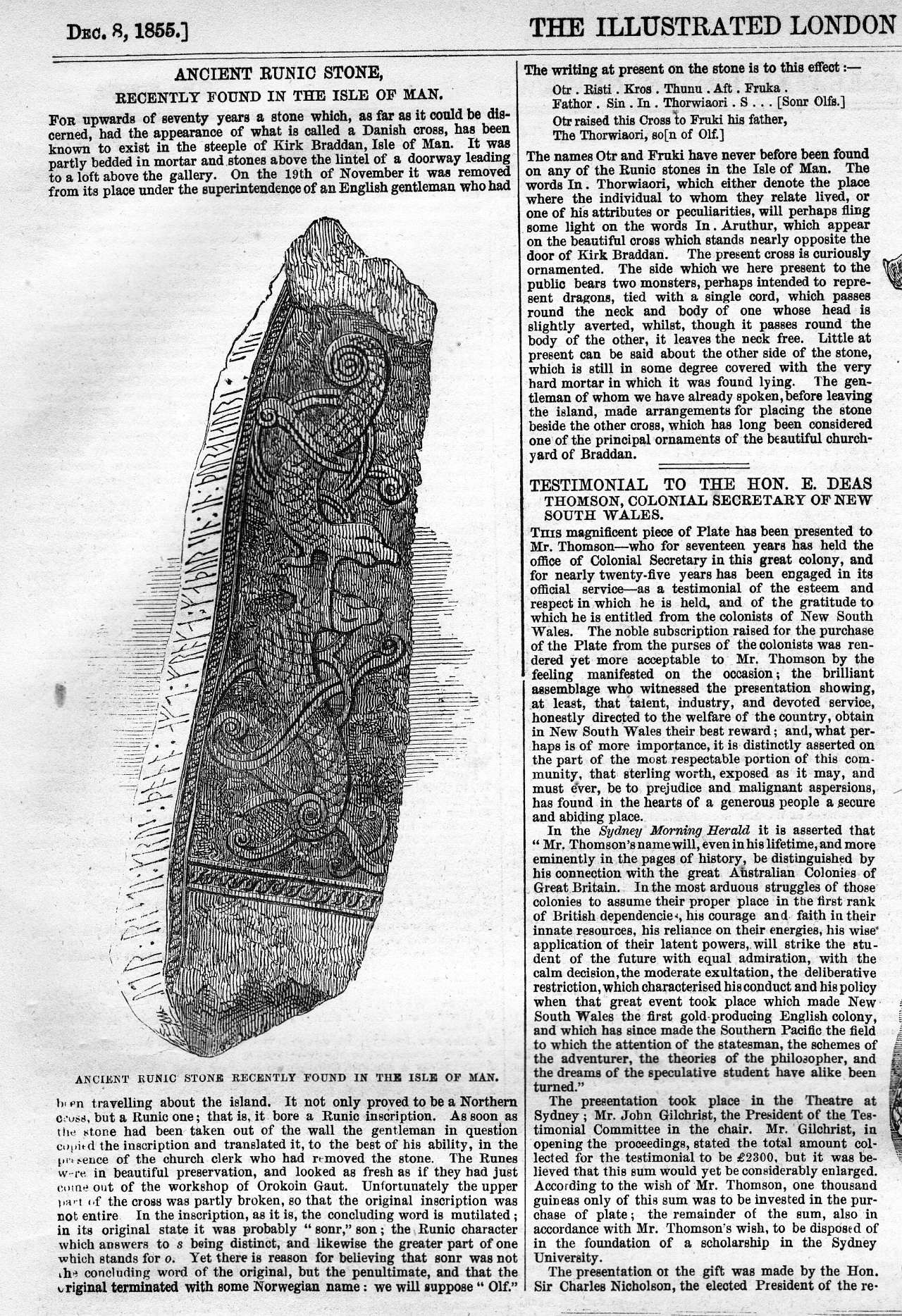
Ancient runic stone recently found in the Isle of Man 1855


ceremony

Ceremony in the Isle of man August 2 1856

A very interesting ceremony was revived at Peel Castle, in this island, on the 23rd of June last. Good Bishop Wilson,
as he is affectionately and deservedly called by the natives of the island, established an
annual Service for the Manx fishermen at the commencement of the season for the herring fishing,
which, kept up for very many years, was at length suffered to fall into disuse.

Last summer, it was for the first time revived by the present Bishop of Sodor and Man;
and on the abovementioned day the service was again performed among the picturesque and interesting ruins of Peel Castle by the zealous prelate.
According to his wish, all classes, from the Lieut.-Governor of the island to the fishermen themselves,
attended and joined in this solemn service. Though it is to be regretted that but few of the fishermen found it convenient to attend,
there were more than on the same occasion last year; and it is to be hoped that they will gradually be induced to attend in greater numbers
and join the rest of the islanders in offering their praises for past mercies and prayers for future success and protection;
for the spirit of piety, for which this interesting and hardy class of men were formerly remarkable,
has not entirely forsaken them, as still, when out at sea, they uncover their heads and bend in silent worship before commencing the night's fishing.

In the accompanying Sketch, the group on the mound is intended to represent the Bishop pronouncing his blessing,
surrounded by a few of his clergy, with two very old fishermen reclining behind them.


Tynwald ceremony

tynwald text

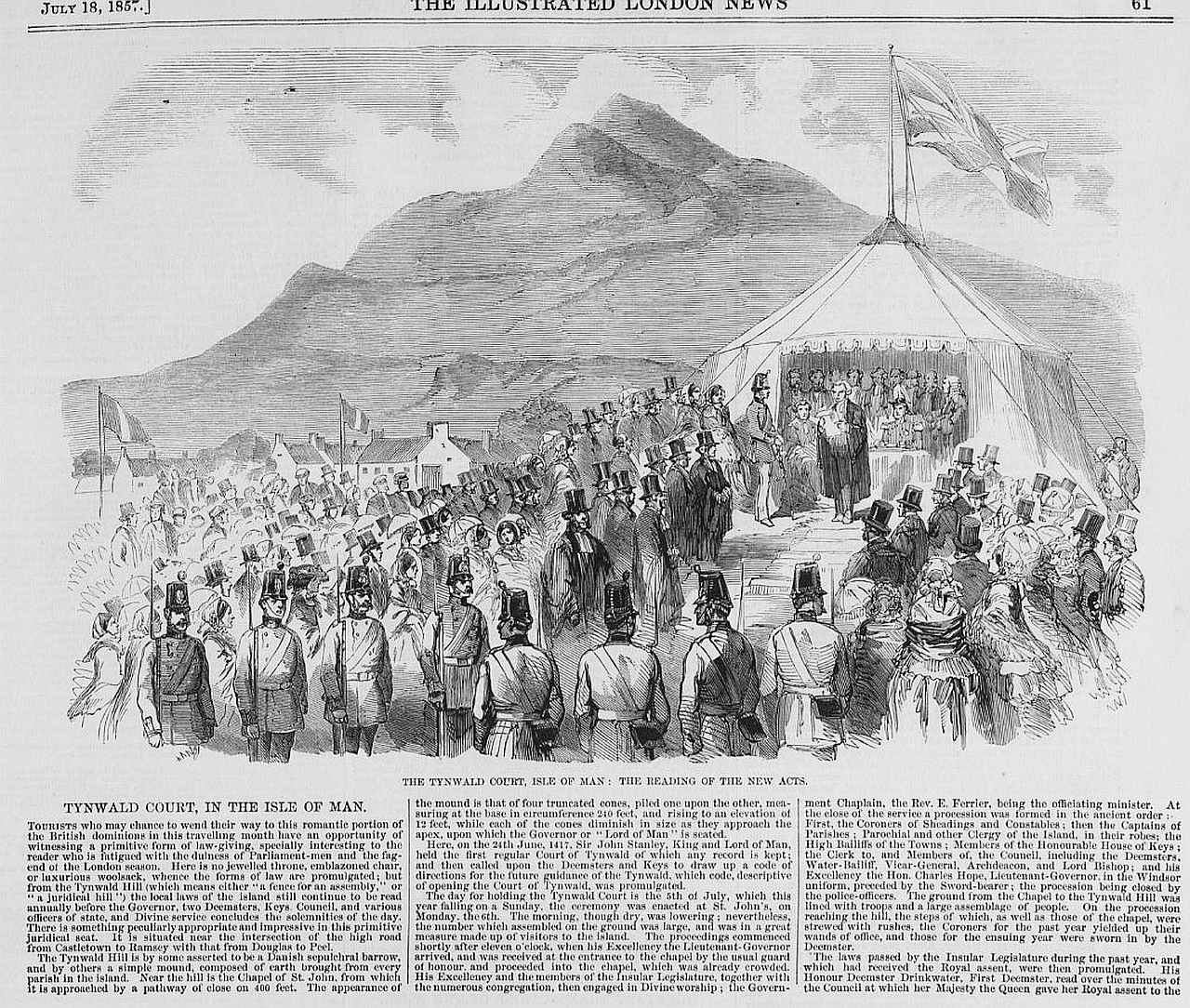
The Tynwald Court, Isle of Man, The reading of the new acts - July 18th 1857

NEXT

NSPCC

This website is completely free to use—no charges, no subscriptions, no catch.
If you find it helpful or enjoyable, and if it’s within your means, please consider making a donation to the NSPCC to support their work protecting children.
Your generosity is entirely optional—your experience here will remain free no matter what.

You can also fundraise for the NSPCC and get a free pack of tips and materials.

Donate to the NSPCC

Home Page


Click here to go to The Year Grid